
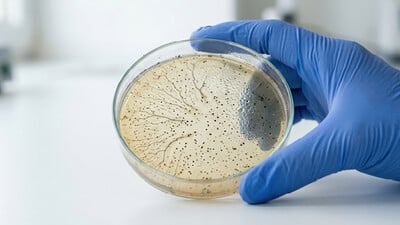
Medical Half the tooling, no manual assembly, and a whole sterilisation step designed out
One tool moulds dish and lid, closed by robot in the ISO Class 8 cell: half the tooling and a sterilisation step designed out.
Read the case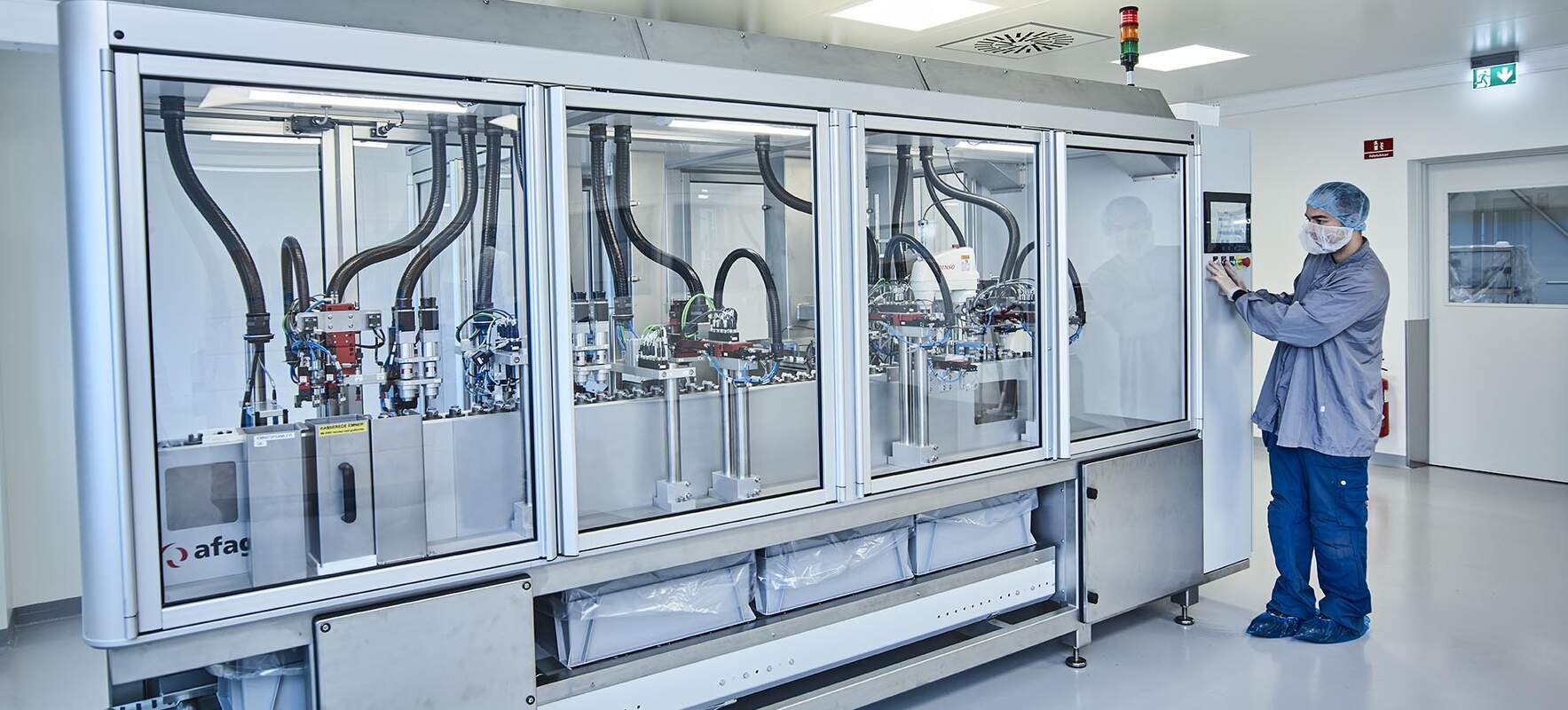
Corona treatment, pad printing, assembly, inspection, packing. One supplier, one documentation trail.
In short: Carmo continues after moulding: corona treatment, pad printing, assembly, inspection and double-bagged component packing all run in an ISO Class 8 cleanroom environment, documented and traceable at every step, from moulded part to packed component.
For more than ten years Carmo has built complete syringe assemblies: we mould the parts, print the graduations, assemble and inspect them, and pack them in the cleanroom, then deliver them ready for the customer’s kitting line. Drug delivery is where this line has its deepest track record, and all of it runs under one ISO 13485 quality management system. One quotation, one qualification, one documentation trail.

Which we use on your part comes down to geometry, volume and how often the print changes; we will say which, and why. The printing stays in-house, inside Carmo’s quality management system and your audit trail.
| Pad printing | Transfer printing | |
|---|---|---|
| Surfaces | curves, recesses and compound shapes | flatter surfaces |
| Volume | higher volumes | smaller series |
| Changing the print | a new cliché | run to run, or part to part |
| Colour | single colour or multicolour | |
| Where it runs | the ISO Class 8 cleanroom environment, alongside assembly and packing | |
The set-up follows your volume: cobot-assisted cells at small volumes, dedicated and fully in-line at volume production; see scalable production at Carmo.
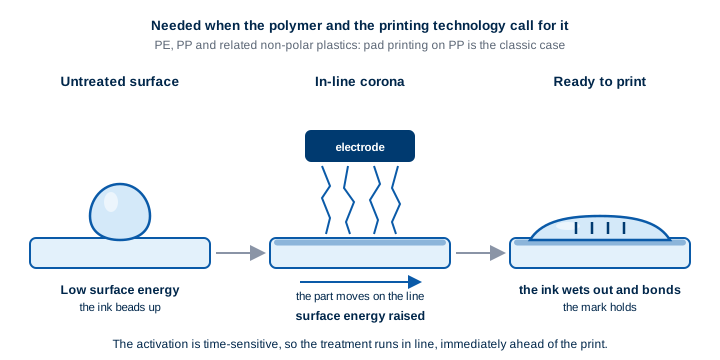
Ink and adhesive barely stick to polyolefins, so some parts need their surface prepared first. In-line corona treatment raises the surface energy just before the print or the bond, so the mark holds. Whether your part needs it depends on the polymer and the printing technology: PP with pad printing is the classic case.

Multi-part components are assembled on highly automated cells, so every unit is built the same way.
Whether to assemble at all, or mould the parts as one 2K component, is typically settled as part of a design for manufacturing (DFM) review.
How automated assembly protects repeatability and cleanliness →
Components are packed inside the validated ISO Class 8 cleanroom, in the format your line needs. Double-bagging lets the inner bag pass into your own cleanroom without a re-bag, with lot and device identification transfer-printed on the pouch, so traceability stays unbroken.


In-line control covers the critical features and measurements agreed with you, vision and leak testing among them. Components travel from press to packed box without crossing a supplier boundary, so the chain of custody stays intact and every box is individually identified.
All under Carmo’s ISO 13485-certified quality management system. Carmo is a component supplier; legal-manufacturer responsibility under MDR rests with the customer.
Send the component drawing and tell us what happens after moulding: assembly steps, markings, packing format, where it goes next. We'll say which steps run in-line, what documentation comes with them, and how the box reaches your line. Running a supplier qualification? Tell us; NDA first if you need it, and a drawing or questionnaire by email ([email protected]) is fine.

One tool moulds dish and lid, closed by robot in the ISO Class 8 cell: half the tooling and a sterilisation step designed out.
Read the case
Nine functional medical components in a medical-grade material: months taken out of a timeline that had already run long.
Read the case
Functional prototypes in the production material in 1–2 days, where a conventional mould tool takes up to six weeks.
Read the caseThe records stay at Carmo; what ships is a Certificate of Conformity (CoC), and a Certificate of Analysis (CoA) where agreed. Held at Carmo and open to your audit: batch records, in-process controls, inspection data and material-lot traceability under the certified ISO 13485 QMS. A unique box ID and timestamp travel on every shipping box, so a box can be traced on top of the lot.
Two technologies, both in-house: pad printing and transfer printing. Pad printing lifts ink from an etched plate with a soft silicone pad, so it reaches curved, recessed and three-dimensional surfaces; transfer printing is the low-volume route, with artwork that can change from one run to the next. Both print graduations, scales and orientation marks, single colour or multicolour, to the tolerance your drawing sets.
Low-surface-energy plastics such as PE and PP have to be activated before ink or adhesive will hold; untreated, they sit below the surface energy durable print adhesion needs. Corona surface treatment raises the surface energy so ink and adhesive wet out and bond. Carmo runs it in-line, immediately ahead of printing and bonding, because the activation decays over time if a part is left to sit.
More than 80 years of continuous private ownership: one team from prototype to volume, no handover.
ISO 13485-certified quality management and an ISO Class 8 cleanroom environment: components with the documentation your audit asks for.
You bring the problem; we bring the know-how to solve it. We don’t walk away from the hard ones. Hear it from our customers.