
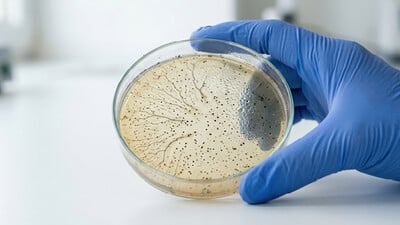
Medical Half the tooling, no manual assembly, and a whole sterilisation step designed out
One tool moulds dish and lid, closed by robot in the ISO Class 8 cell: half the tooling and a sterilisation step designed out.
Read the case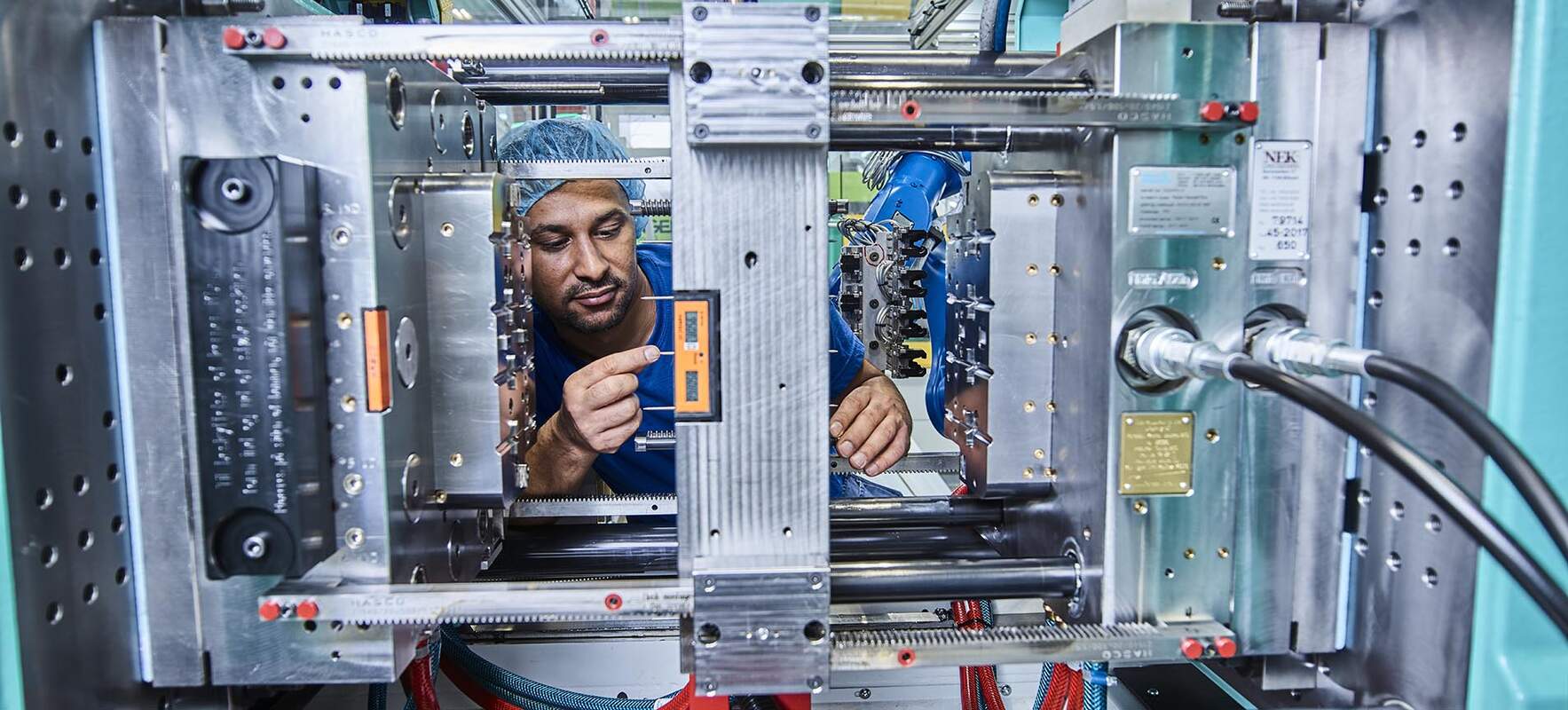
Plastic moulded around a metal insert: threads, contacts and reinforcements, one part.
In short: insert moulding locks a pre-made component, usually metal, into one moulded part: threads, contacts and reinforcements with no downstream assembly. Carmo runs it in-house under the ISO 13485 QMS; the patented Carmo Metal Reinforced Eyelet is the clearest example.
Insert moulding moulds plastic around a pre-made component, most often a metal part, loaded into the tool before the shot. Carmo runs insert moulding in-house, as part of its injection moulding of plastic components.
A finished component, the insert, is placed into the mould by hand or by robot. Plastic is moulded around it, locking it in place in a single cycle.
Because plastic doesn’t chemically bond to metal, the insert is held mechanically: undercuts, knurls, holes or grooves key the plastic to the metal. The result is one part instead of an assembly.
Inserts are typically metal (brass, steel or stainless) but can be ceramic or a pre-moulded plastic. The surrounding polymer is chosen for the job: engineering thermoplastics for strength, medical grades for devices, including proprietary Carmo PVC recipes. Insert placement, tolerance and mechanical keying are designed in from the start.
Plastic around metal is the hardest case to separate at end of life: the insert has to come out before the polymer can be recycled, which is worth weighing at design stage against the assembly steps the insert removes. Can multi-material components be recycled?
Carmo’s Metal Reinforced Eyelet is made this way: a metal ring, the pre-made insert, is loaded into the tool, and a plastic flange is moulded onto it, keyed mechanically. It is a patented, one-piece eyelet that combines the strength of metal with the weldability and finish of plastic.

The difference is the first part. Insert moulding moulds around a pre-made component (often metal); overmoulding moulds over a part that was itself moulded first (usually plastic); 2K moulds two materials in one tool, in one cycle. Which of the three fits your part is typically settled as part of a design for manufacturing (DFM) review. Read more: Overmoulding vs insert moulding and 2K moulding.
Whichever technique fits your part, it is produced in-house under Carmo’s ISO 13485-certified quality management system, documented and traceable like every component we make.
Tell us the insert, the polymer and the volume. We'll propose the retention design and whether insert moulding, overmoulding or 2K fits your part best.

One tool moulds dish and lid, closed by robot in the ISO Class 8 cell: half the tooling and a sterilisation step designed out.
Read the case
Nine functional medical components in a medical-grade material: months taken out of a timeline that had already run long.
Read the case
Functional prototypes in the production material in 1–2 days, where a conventional mould tool takes up to six weeks.
Read the caseInsert moulding moulds plastic around a pre-made component, most often metal, placed in the tool before the shot. Threaded inserts, contacts and reinforcements become one integrated part, with no downstream assembly.
Mechanically. Plastic does not bond chemically to metal, so undercuts, knurls, holes or grooves key the plastic to the insert and lock it in place.
The first part. Insert moulding moulds around a pre-made component (often metal) loaded into the tool; overmoulding moulds over a part that was itself moulded first (usually plastic).
Yes. Insert moulding runs in-house at Carmo under the ISO 13485-certified quality management system, with the insert loaded by hand or by robot. Documentation and traceability for every component are covered under quality assurance at Carmo.
More than 80 years of continuous private ownership: one team from prototype to volume, no handover.
ISO 13485-certified quality management and an ISO Class 8 cleanroom environment: components with the documentation your audit asks for.
You bring the problem; we bring the know-how to solve it. We don’t walk away from the hard ones. Hear it from our customers.