
Half the tooling, no manual assembly, and a whole sterilisation step designed out
One tool moulds dish and lid, closed by robot in the ISO Class 8 cell: half the tooling and a sterilisation step designed out.
The challenge
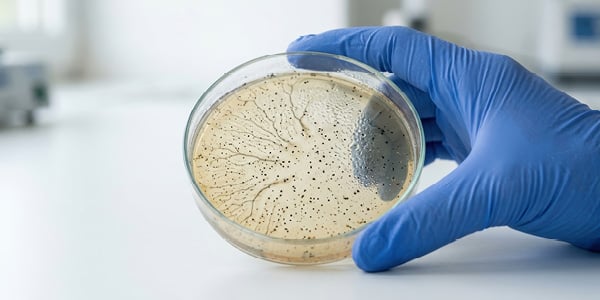
The customer makes a near-patient diagnostic test used in general practice: a compartmented agar dish that lets a clinician culture a patient sample and read which antibiotic will work — in the clinic, overnight, without sending the sample to a laboratory. Used at scale, it is a small piece of plastic doing a serious job: getting the right antibiotic to the patient first time — and curbing the inappropriate prescribing that drives antibiotic resistance.
The agar is filled on the customer’s own automated line. With their previous supplier the dish took two separate tools — one for the dish, one for the lid — plus a manual assembly operation to bring the halves together, and a full terminal sterilisation process before the empty dishes could enter the filling line. Two moulds to pay for and maintain; labour and variability in hand-assembly; and the cost, lead time and carbon footprint of sterilisation — all before a drop of agar went in.
The solution
Carmo didn’t quote the existing design. It rethought the part from the mould outward.
Normal injection-moulding practice pairs parts of similar geometry in a single family tool, so the molten plastic fills every cavity evenly. A dish and its lid are nothing alike. Carmo designed one tool that moulds both together anyway — and solved the flow-balancing problem that makes moulding two such unequal parts in one tool so difficult.
From there the cell does the rest: a robot lifts the freshly moulded top and bottom, closes them immediately, and the closed dishes are stacked and flow-packed — the whole sequence inside an ISO Class 8 environment. Moulded, closed and packed without handling or exposure, the dishes leave the cell with a bioburden below 1 CFU per dish — low enough that the separate sterilisation step was no longer needed.
One more move only a moulder would think of: by selecting a material that raises the friction between stacked dishes, Carmo made the stacks sit more stably in the customer’s automated filling equipment — lifting yield and throughput on a line Carmo doesn’t own.
The result
- One tool instead of two — roughly halving the tooling investment.
- The manual assembly operation removed entirely.
- An entire terminal sterilisation process designed out — with its cost, lead time and carbon footprint.
- Bioburden below 1 CFU per dish straight out of the moulding cell — low enough to remove the separate sterilisation step.
- More stable stacks — and higher yield and throughput — on the customer’s own filling line.
The value to the customer
This is what “solving the part nobody else could mould in one tool” actually buys. The saving isn’t a cheaper dish — it’s a simpler process: fewer tools, fewer steps, no hand-assembly, no separate sterilisation, a smaller carbon footprint, and a steadier feed into the customer’s line. Carmo questioned the two-tool design everyone had accepted, and the answer took cost and a whole process step out of the product permanently.
And underneath the engineering, the dish keeps doing the thing that matters: helping a clinician get the antibiotic right, first time.
See how we take a concept to volume production: one site, no handover.


