
Choosing an injection moulding partner for medical device components is a decision you live with for years: once a component is validated into your device file, changing supplier means requalification, revalidation and regulatory work, often at a cost that exceeds the value of the components themselves. An ISO 13485 certificate is an entry ticket, not the decision; these twelve criteria, and the questions under each, are what separate certificate-holders from partners.
Take the questions into your next supplier meeting. The twelve questions and the red flag under each, on one page:
1. Read the certificate itself, not the claim
Suppliers often state that they are ISO 13485 certified, but the certificate itself tells you who issued it, which accreditation stands behind the certifier, what the scope actually covers, and when it expires. A scope covering only manufacture is a different capability profile from one covering design, development, manufacture and assembly.
Ask, for the certificate PDF, and verify the certifier, accreditation (e.g. DANAK, UKAS, DAkkS), scope wording and validity dates.
Watch for, certification documentation that is unavailable, out of date or inconsistent with the services being offered.
2. QMS maturity: how many audit cycles has it undergone?
ISO 13485 certifies the quality management system, not the products. A QMS that has been through multiple surveillance and recertification audit cycles is stronger evidence of process maturity than one that just passed its first.
Ask, how long has the QMS been certified? How many recertification cycles has it completed? When was the last customer audit, and may we conduct one as part of supplier qualification?
Watch for, certification obtained recently, with little audit history behind it.
3. Role clarity under MDR: who is responsible for what?
Under the EU Medical Device Regulation (2017/745), responsibility for the finished device remains with the legal manufacturer, the OEM placing it on the market. The supplier’s responsibility is the component and the documentation that supports your device file. Suppliers should be able to explain this distinction clearly and consistently.
Ask, describe your role under MDR. Which ISO 13485 requirements are excluded from your certification scope, and why?
Watch for, claims that components are “MDR certified” or “MDR compliant”. Components are not CE-marked under MDR; medical devices are. In regulatory matters, precision of language often reflects precision of process.
4. One team from prototype to volume, or a handover at scale-up?
Every supplier handover resets learning, the tolerance discussions, the material discoveries, the decisions that never made it into the drawings, and in a regulated programme it can also mean revalidation.
Ask, who carries the project from prototype through validation and into volume production? Will the same engineering team remain responsible throughout?
Watch for, “we have partners for production”: a handover with a friendly name.
5. Prototypes in production materials: what you test is what you ship
A prototype in a substitute material tells you about geometry, not necessarily behaviour, and medical components live or die on material behaviour: weldability, flexibility, chemical resistance, ageing. Testing in the material you will mould at volume means your validation builds on your prototypes instead of starting over.
Carmo Print Moulding: we 3D-print the mould tool, then injection-mould functional prototypes in the actual production material, the speed of 3D printing with the accuracy of injection moulding, ready for testing in days.
Transcript
What is Carmo Print Moulding? Well, you've probably heard about so-called rapid prototyping. Frankly, it's nothing more than conventional 3D printing. Unfortunately, this is not always as fast as one might hope. Also, only a few particular materials are suitable for the process, making it extremely difficult to get accurate properties of the future product. Not to mention traditional prototyping with aluminium tools, which is even more time-consuming and costly. And this is where Carmo Print Moulding comes into play. We invented a much more rapid way to do rapid prototyping. And, by the way, a lot more cost-efficient too. The thing is, we 3D print prototyping tools, not prototypes. And then we injection mould prototypes into the right material. When the design is ready, it takes us just one day to 3D print the mould. Iterations, tests and experiments can then be completed quickly, flexibly and cost-efficiently. Years of experience enables us to develop smart and mature mould designs that ensure robust and durable components. Yes, it is just as good as it sounds. You get the speed of 3D print and the accuracy of injection moulded prototypes, all in the exact right material ready for testing. Take the best from both worlds in one innovative solution. Carmo Print Moulding: more rapid than rapid prototyping.
Ask, can you provide functional prototypes in the intended production material, including multi-component (2K/3K) parts? What lead times, tooling requirements and costs are involved?
Watch for, prototyping offered only in 3D-print resins or substitute materials, with production material available only after full tooling investment.
6. Validation as routine, not exception
For medical-device components, process validation should be a defined, repeatable part of production. Installation Qualification (IQ), Operational Qualification (OQ), Performance Qualification (PQ), First Article Inspection (FAI) and capability studies provide the documented evidence that a process consistently produces components to specification. How a supplier talks about validation reveals whether it is routine.
Ask, describe your standard validation approach for a new medical-device component. Can validation be performed at component level to our requirements? Can you provide an example report structure (redacted is fine)?
Watch for, validation described as “available on request” with no standard procedure behind it.
7. Cleanroom claims with the standard attached
“Cleanroom production” means little without three specifics: the standard, the class, and which operations actually run inside the classified environment. ISO 14644-1:2015 classifies airborne particle concentrations: classification is a measured, monitored state, not a product certificate.
Ask, which cleanroom standard and classification apply? Which operations, moulding, assembly, inspection, packaging, are performed within the classified environment? How is it monitored and verified?
Watch for, references to an “ISO-certified cleanroom” without a stated standard, classification or clear description of what runs inside the classified environment.
8. Traceability from resin lot to shipped component
When a complaint, an audit or a material-change notification arrives years into production, traceability depth decides whether you can identify the affected materials, processes and shipments in hours or in weeks.
Ask, if we identify a shipped batch, how far back can you trace it, and how fast? How are raw-material suppliers evaluated, and are they contractually required to notify you of changes?
Watch for, claims of full traceability that cannot be demonstrated through a practical retrieval example.
9. Material mastery for your component class
Certificates are generic; material expertise is not. A supplier with compound-level depth in your material class, soft PVC, PVC/PUR blends, TPE, 2K/3K combinations, catches at the design review what a generalist discovers at validation; own recipes also mean the formulation can’t be discontinued out from under you.
Ask, which material classes do you master at compound level? Can you support material selection against performance, regulatory and manufacturing requirements, and document material provenance?
Watch for, “we mould all materials” with no depth in yours.
10. Will the supplier still exist for your device’s regulated life?
A validated supplier is an asset in your regulatory file; an acquisition or restructuring mid-programme turns the asset into a project. Ownership stability and customer-relationship longevity are legitimate qualification criteria: arguably the most under-checked ones.
Ask, who owns the company, and for how long has the current ownership structure been in place? What is the longest-running customer relationship currently supported in production?
Watch for, ownership questions answered vaguely, or a supplier history defined by acquisitions and strategy resets.
11. Volume economics in Europe: automation, not promises
European manufacturing competes with low-cost regions on one axis: automation. Nearshoring only works economically if the automation is real, and the same automation carries consistency and scalability as volumes grow.
Ask, what share of your production runs automated? Can we see the production floor, physically or on video? How do you quote at 10× and at 100× current volume?
Watch for, a European location sold as a value in itself, with no automation story behind the unit price.
12. Sustainability data you can actually put in your report
Scope 3 reporting, accounting for the emissions in your supply chain, is moving from voluntary to expected. A supplier’s sustainability page is not data; a per-component CO₂ figure you can enter into your own reporting is.
Ask, can you provide component-level CO₂ data for our parts, and from what system? Do you hold a Science Based Targets initiative commitment, and what is the registration?
Watch for, a sustainability page full of intentions, with no numbers available at component level.
How Carmo answers these twelve
We wrote this guide the way we would want to be evaluated ourselves. For transparency, here is where Carmo stands on each criterion:
| Criterion | Where Carmo stands |
|---|---|
| 1 · Certificate | Carmo A/S's quality management system is certified to ISO 13485:2016 Medical devices quality management system by Bureau Veritas (accredited by DANAK), certificate no. DK020611. Scope: Design, development, manufacture and assembly of injection molded plastic components. Valid: 2. September 2026 – 1. September 2029. All Carmo plastic components are manufactured under the same QMS and procedures. |
| 2 · QMS maturity | Certified quality management system since 1993; ISO 13485 since 2013. Customer audits are part of normal life at Carmo. |
| 3 · MDR role | Carmo is a component supplier. Legal-manufacturer responsibility for the finished device rests with the OEM placing it on the market; Carmo delivers components built and documented to the standard your QMS requires. The exclusions in our certification scope are documented and explicit. |
| 4 · Prototype to volume | The same engineering team carries a project from first iteration through validation into volume production: no supplier handover at scale-up. Development, moulding and assembly sit together in Espergærde, Denmark. |
| 5 · Production materials | Carmo Print Moulding, our own integration of 3D-printed tooling and injection moulding, delivers functional prototypes in production materials, including 2K, in days. In the EYE-GO development programme this cut development cost by 40–50%. |
| 6 · Validation | IQ/OQ/PQ, first article inspection and capability studies run as standard procedure under the QMS. Validation can be performed at component level to customer requirements. |
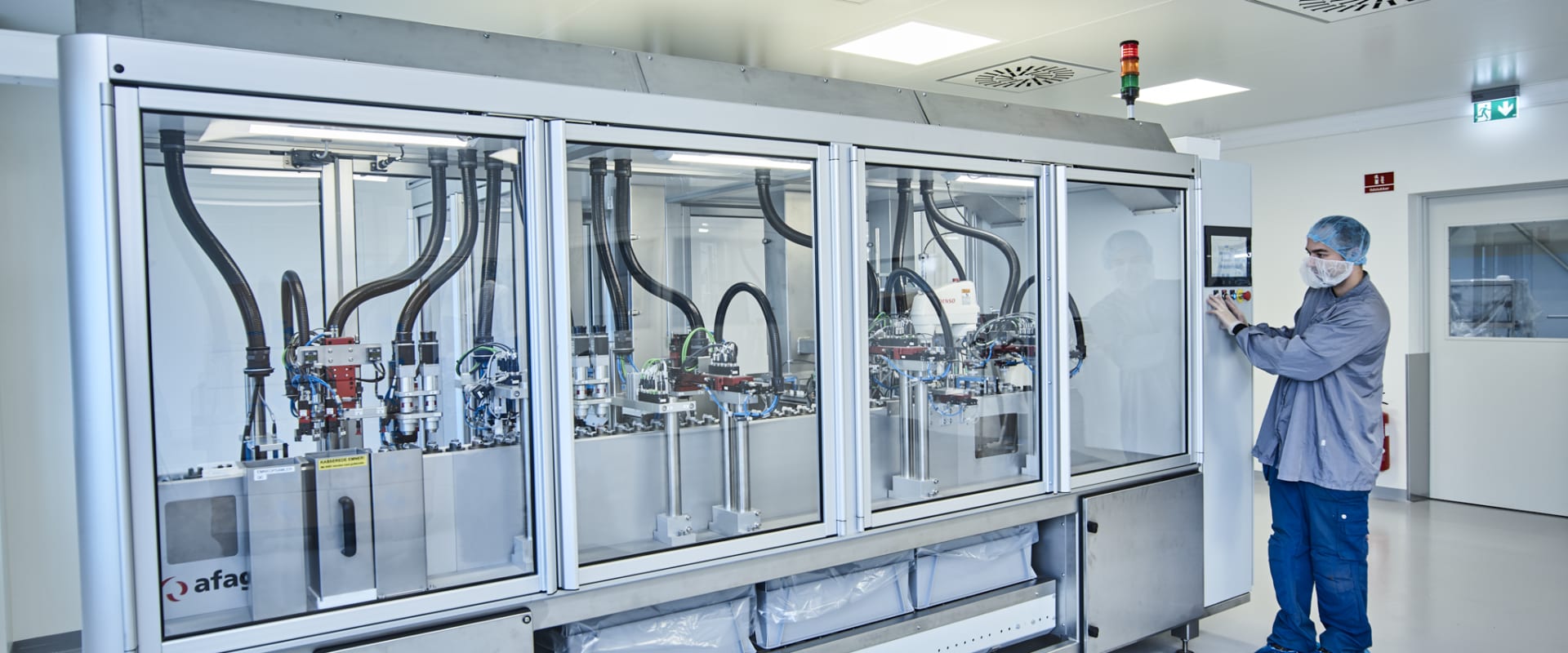
| 7 · Cleanroom | Carmo operates a validated ISO Class 8 cleanroom for assembly, inspection, printing and packaging of medical components. Injection moulding runs in Class 8 production cells under Carmo’s ISO 13485 quality management system; both environments are classified per ISO 14644-1:2015. Particle levels are monitored through routine internal measurements and verified annually by an external specialist. |
| 8 · Traceability | Component-level traceability under the certified QMS; suppliers are evaluated, monitored, and contractually required to notify Carmo of changes to purchased products. |
| 9 · Materials | Own proprietary PVC and PVC/PUR compounds developed over decades, plus PP, PE and TPE, with 1K, 2K and 3K moulding in-house. Material selection support is part of every development engagement. |
| 10 · Longevity | Founded 1941; three successive owners, no acquisitions, no strategy resets; privately and independently owned for more than 80 years. Customer relationships of 20–30 years are the norm, not the exception. |
| 11 · Volume economics | Automation and robotics are integral to production in Espergærde: Danish manufacturing at unit costs that hold up against low-cost-country alternatives. |
| 12 · Sustainability data | A per-component CO₂ calculator integrated in our ERP supports customers’ scope 3 reporting at component level. Carmo is committed to the Science Based Targets initiative (commitment 40001785): a 50% reduction in scope 1 and 2 emissions by 2030. |
If you are qualifying suppliers for a medical component programme, or want to pressure-test these twelve questions on us, talk to our team. We will answer all twelve, with documents.

