
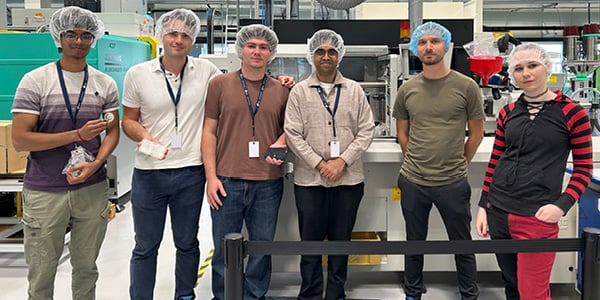
Carmo and DTU Explore New Opportunities for 3D-Printed Tooling
At Carmo, we have worked with 3D-printed tooling for more than five years as part of our prototyping and product development efforts with customers. The technology offers significant advantages in flexibility and speed, allowing us to move quickly from design to functional parts.
One of the key challenges, however, has always been the limited lifetime of 3D-printed moulds. To complete a development project, it is often necessary to produce multiple moulds for each iteration, increasing both time and cost.
When we learned that DTU was investigating ways to improve the durability of 3D-printed moulds, and had already obtained promising preliminary results, we saw an opportunity to contribute with our practical experience in injection moulding and join the investigation.
This project was conducted alongside Carmo’s collaboration with DTU in the Additive Manufacturing Program initiative, where Carmo, DTU and industry partners are working to advance and industrialize additive manufacturing technologies for future production and product development applications. The insights and results generated through this project will contribute valuable knowledge to the ongoing AM development activities.
Turning Research into Practice
The collaboration took place as part of DTU’s course Experimental Methods in 3D Printing, where students work on real industrial challenges together with company partners.
During the three-week project, students and researchers from DTU worked closely with Carmo to evaluate different materials and post-curing methods for 3D-printed mould inserts. The project included multiple moulding trials at Carmo, providing an opportunity to test the solutions under realistic production conditions.
For Carmo, participation offered access to a scientific testing setup that would have required considerable time and resources to establish internally. It also provided valuable insight into how different process parameters influence the performance of 3D-printed tooling.
A Promising Direction for Future Development
The project demonstrated that post-curing plays an important role in the durability of printed moulds. Across the tested scenarios, moulds cured under vacuum consistently showed a longer service life than those cured using more conventional methods.
While the findings do not represent a definitive milestone, they provide a clear indication of where future development efforts should focus. Further testing and investigation will be needed, but the results strengthen our confidence that there is significant potential to improve the performance and economic viability of 3D-printed tooling.
The Value of Collaboration
Projects like this highlight the value of collaboration between industry and academia. By combining DTU’s research capabilities with Carmo’s manufacturing experience, we can investigate challenges that are difficult to address independently and generate knowledge that benefits both research and industrial practice.
We would like to thank the DTU students Arindam Thander, Edoardo Toscano and Osman Köse, DTU Construct researchers Venkata K. Nadimpalli and Marina Artemeva, and our colleagues Tobias Kristensen and Vicki Thygesen for their commitment and contribution to this project. We look forward to continuing the dialogue and exploring how additive manufacturing can create even greater value in product development and small-series production.
Ready to discuss your next project?
Bring us your challenge, not just your specifications. Every project begins with a confidential conversation under NDA, allowing us to explore the best solution together.
Contact VP, R&D and Technology, Anders Johnsen at +45 4912 2102